Workers Urge Air France Chiefs to Stop Expelling Immigrants July 12, 2007 - The Associated Press
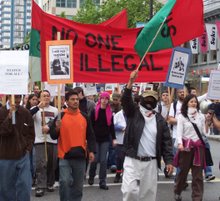
PARIS: Airline unions urged Air France on Thursday to stop expelling illegal immigrants on its flights, saying the practice upsets flight attendants and passengers and may hurt business at France's flagship carrier. Workers for five unions were presenting their demands at the Air France-KLM annual shareholders' meeting in Paris. For years unions have urged the airline to halt the expulsions, but the demand attracted extra attention this year because of President Nicolas Sarkozy's determination to step up expulsions as part of his tougher policies on immigration. Every year, thousands of illegal immigrants are put aboard Air France flights and sent to their homelands, sometimes handcuffed and escorted by police. On occasions, they resist and must be forcibly restrained. Air France unions CGT, CFDT, SUD, ALTER and SPAF voted Tuesday to ask the company to refuse to transport expelled immigrants.
Click here to read more
Showing posts with label Labour. Show all posts
Showing posts with label Labour. Show all posts
Friday, July 20, 2007
Saturday, June 23, 2007
Choices for Black labor
Choices for Black labor by Bill Fletcher; Black Commentator; June 23, 2007
I came of age politically in the middle of the Black Power movement. Within the ranks of organized labor, both the Black Power movement and the Anti-Vietnam War movement had a significant impact through the mid1970s. Caucuses were being formed to challenge the bureaucratic leaderships of many unions. Wild-cat strikes were taking place in workplaces around the country. And in some locales, independent unions were being established where workers had concluded that the established union movement was incapable of making any significant changes to address the needs and demands of rank and file workers. At the national level, the Coalition of Black Trade Unionists emerged as a major voice arguing that organized labor needed to take a new and different look at the Black worker, a look and engagement that was based on the need for respect and equality.
As we enter the 21st century, Black labor is in disarray. Within the ranks of organized labor, the various institutions that have often spoken on its behalf have ossified. Black caucuses in various unions have stepped back from challenging and pushing the union leaderships and instead have in all too many cases degenerated into social clubs or step-ladders for individuals to get positions in the union structure. While there are greater numbers of Black staff and, in some cases, elected leaders, there is an emphasis on acceptability—to the leadership of organized labor—within the ranks of the movement, rather than an emphasis on challenge and struggle.
(Click here to read more)

Monday, June 11, 2007
Iraq government orders arrest of oil workers' leaders
Iraq government orders arrest of oil workers' leaders by Naftana Press Release; June 09, 2007
Iraq's powerful oil workers' trade union today expressed alarm as an arrest warrant was issued for its leaders, in an attempt to clamp down on industrial action. Members of the union have been on strike since Monday 4th June, in protest at the government's failure to meet any of its promises made in a meeting with Prime Minister Nouri al-Maliki on 16th May. The union's 16 demands included improvements to wages, health and other working and living conditions as well as consultation on the proposed oil law, which the union opposes. The union added a 17th demand yesterday demanding the sacking of the General Manager of the Southern Pipeline Company.
On Tuesday, al-Maliki warned that he would meet threats to oil production "with an iron fist". The arrest warrant, based on a charge of "sabotaging the economy" specifically names Hassan Juma'a Awad, the leader of the 26,000-strong Federation of Oil Unions, and three other leaders of the Federation. Hassan Juma'a commented, "the government is intimidating the union but we are determined to gain our legitimate rights." He added that the strike would continue in accordance with the union's plan.
(Click here to read more)
Sunday, May 20, 2007
Feds crack down on immigrant labor organizers
by David Bacon. May 19, 2007. The American Prospect
Red Springs, North Carolina (5/10/07) -- To organizer Eduardo Peña, "the raid was like a nuclear bomb" - more precisely, a neutron bomb, that ingenious weapon of the cold war whose radiation was meant to kill a city's residents, but leave its buildings standing. After the immigration raid of January 24 at the Smithfield pork slaughtering plant in Tar Heel, North Carolina, the factory was still intact. The machinery of the production lines was fully functional, ready to clank and clatter into its normal motion. But many workers were gone, and much of the plant lay still.
That day the migra [agents of Immigration and Customs Enforcement, part of the Homeland Security Department] picked up 21 people, while trying not to alert the rest of the plant's laborers. One by one, supervisors went to Mexicans on the line. You're needed in the front office, they'd say. The workers would put down their knives, take off their gloves, and walk through the cavernous building to the human resources department. There ICE agents took them into custody, put them in handcuffs, and locked them up in a temporary detention area. Later, they were taken out in vans and sent to immigration jails as far away as Georgia.
(Click here to read more)
Saturday, May 19, 2007
Bipartisan Senate plan would deepen exploitation of immigrant workers
Bipartisan Senate plan would deepen exploitation of immigrant workers By Barry Grey18 May 2007
A group of Democratic and Republicans senators on Thursday announced a bipartisan proposal to overhaul the US immigration system that contains punitive measures against undocumented workers currently in the US and regressive provisions that would prevent future immigrants from bringing parents, adult children or other family members into the country. Details of the proposed legislation, which runs 380 pages, remain sketchy. However, certain key points are clear.
The plan contains discriminatory and anti-democratic language provisions, requiring immigrants seeking permanent legal status to learn English, and mandates a massive expansion, to 18,000, of the border patrol police, the erection of 370 additional miles of fencing on the US-Mexican border, and a hi-tech employment verification system for immigrant workers. It would also establish temporary worker programs to vastly expand the number of immigrant workers brought into the country to serve as highly exploited cheap labor for agribusiness and other corporate interests. The plan would allow most undocumented workers who entered the US before January 1 to receive a temporary residency permit until they obtained a “Z Visa,” which would enable them to live and work in the US legally. However, they would have to pay a $5,000 fine and administrative costs before receiving the “Z Visa,” and face the prospect of waiting eight to thirteen years before achieving permanent residency.
Monday, May 7, 2007
Two Chinese Foreign Workers Dead in Alberta
Two dead, four injured in roof collapse at job site north of Fort McMurray (Roof-Collapse)
FORT MCKAY, Alta. (CP) _ Two workers were killed and four others injured Tuesday when a roof collapsed at a Canadian Natural Resources Ltd. job site north of Fort McMurray.The company said in a news release that the 2:30 p.m. accident involved a roof support structure at the tank erection site of the Horizon Oil Sands Project.“All authorities have been notified of this incident,‘‘ the company said in a news release.“The site has been immediately secured and injured workers are receiving appropriate medical attention by the on-site medical staff.‘‘A worker told CTV Edmonton it was windy and the large tank just flew apart.“I heard this horrible noise, just crashing steel, smashing, crashing, and I looked over and I saw bunch of steel flying, these huge towers they use for holding up the tank roof,‘‘ the unidentified worker said.All workers were evacuated from the site, the worker said.
Gil McGowan, president of the Alberta Federation of Labour, said he received a few phone calls from union members at the site.“They told us there‘d been an accident on the Horizon site involving temporary foreign workers from China brought in by CNR or one of their contractors to work on a big tank farm on the Horizon site,‘‘ McGowan said.“Our understanding is that one of the big tanks collapsed and in the process at least two workers were killed and as many as four were injured.‘‘McGowan said he did not know what caused the collapse.“That‘s all we got before our members‘ cell phones were confiscated by management.‘‘Barrie Harrison, communications officer for Occupational Health and Safety, also said it‘s not clear what happened.He could not confirm if the workers were from China and did not know their ages or gender.
(Click here to read more)
Thursday, April 19, 2007
China's part-time McWorkers exploited
China's part-time McWorkers exploited By Olivia Chung HONG KONG
Legal loopholes, lax supervision and local corruption are allowing US fast-food giants to underpay part-timer workers in China. The current labor law, effective since 1995, has been criticized by human rights and union activists for being more protective of employers than of workers. Experts are urging the Chinese government to draft a new labor law so that the rights of both full-time and part-time employees are equally protected. The following is an example of how a part-time working student is underpaid and his rights are not fully protected.
Struggling to earn enough to pay his tuition fees, Tong (not his real name) started working a part-time job at McDonald's in Guangzhou in January 2006 and was impressed by the US fast-food restaurant's nice atmosphere and neat environment. "At first, I didn't feel I was underpaid because the salary the restaurant offered was similar to those offered by domestic restaurants," said Tong, a third-year undergraduate, "but after a long day of work, I felt it was a bit unfair. It's a hard-knock life." According to the contract he signed with McDonald's, Tong's basic salary plus subsidy is 5.3 yuan (68.7 US cents) per hour.
(Click here to read more)
NY: Wobblies Organize Brooklyn Warehouses
Wobblies Organize Brooklyn Warehouses by Caitlin Esch
In 1903, when Japanese and Mexican immigrant workers wanted to unionize in California, the American Federation of Labor denied them a union charter, refusing to work with non-whites. The Industrial Workers of the World, on the other hand, embraced workers of all colors, as long as they were a little “red.” At less than $4 an hour, some Mexican workers in Brooklyn today earn little more than they would have in 1903—and these workers are again turning to the IWW.
On March 10, in the sparsely inhabited industrial graveyard that straddles the borough divide between Brooklyn and Queens, 15 to 20 people picketed outside EZ-Supply/Sunrise Plus, a food distribution warehouse, to protest labor abuses. EZ-Supply/Sunrise Plus employs about 25 workers and is the largest of five food distribution warehouses in the area where workers are trying to unionize. The others—Amersino, Giant Big Apple Beer, Top City and Handyfat—employ about 65 workers total. IWW organizer and do-rag bestyled Billy Randel explains that the point of the small picket, far from the eyes of the public, is to remind the owner, one Mr. Lester Wen, that he is being watched. Randel elaborates, “This warehouse is really bad. It’s one of the worst. When we first came in here about a year ago, workers were working 60 to 70 hours for around $350 a week.”
(Click here to read more)
Sunday, April 15, 2007
Farm Labor Organizer Murdered in Mexico
Labor Contractors Suspected Farm Labor Organizer Murdered in Mexico By DAN La BOTZ
Santiago Rafael Cruz, an organizer for the Farm Labor Organizing Committee (FLOC) based in Toledo, Ohio, was found murdered in the union's office in Monterrey, Mexico on the morning of April 9. He had been bound hand and foot and beaten to death. Circumstances suggest labor contractors may have had him killed. Cruz, 29, had worked for FLOC in the United States for four years organizing immigrant agricultural workers. For less than a month working for the FLOC in the Monterrey office that was set up in 2005 to help process H2A visa workers whose employers were under FLOC contracts. FLOC has asked the AFL-CIO and Rep. Marcy Kaptur's (D-Ohio) to request that the U.S. State Department press the Mexican government to conduct a thorough and speedy investigation to bring the killers to justice. John Sweeney, president of the AFL-CIO, has called on the Mexican and U.S. governments to ensure that there is a "thorough and professional investigation" of the murder. FLOC has asked the Inter-American Human Rights Commission to take on Cruz's murder as an official case.
Who would want Cruz killed? To answer that question we have to understand the labor contracting system in Mexico.
Thursday, April 12, 2007
AFL-CIO Again Rejects Guest Worker Programs
Expanding Guest Worker Program—a No Winner for Immigrants or the Nation. By James Parks, Apr 10, 2007
In today’s Los Angeles Times, AFL-CIO President John Sweeney and Pablo Alvarado, executive director of the National Day Laborer Organizing Network, describe how temporary worker programs will negatively impact immigrant workers—and the nation.
Those programs
"will assure a steady flow of cheap labor from essentially indentured workers too afraid of being deported to protest substandard wages, chiseled benefits and unsafe working conditions. Such a system will create a disenfranchised underclass of workers. That is not only morally indefensible, it is economically nonsensical. We’ve had plenty of bad experiences with such shortsighted answers to a complicated problem."
(Click here to read more)
Sunday, April 8, 2007
Real Political Purpose of the ICE Raids
The Real Political Purpose of the ICE Raids. New America Media, Commentary, David Bacon, Posted: Mar 30, 2007
For the last several months, agents of Immigration and Customs Enforcement (ICE) have carried out well-publicized immigration raids in factories, meatpacking plants, janitorial services, and other workplaces employing immigrants. ICE calls the workers criminals, because immigration law forbids employers to hire them. But while workers get deported, and often must leave their children with relatives, or even strangers, don't expect to see many of their employers go to jail. Further, ICE can't, and won't, deport all 12 million undocumented workers in the country. This would quickly halt many industries. Instead, these raids have a political purpose.
(Click here to read more)
Saturday, March 24, 2007
Labour Double-Standards Blamed for Farmworkers' Deaths
Relatives, unions decry declining standards. By Tom Sandborn. March 16, 2007. TheTyee.ca
Did Amarjit Kaur Bal, Sarabjit Kaur Sidhu and Sukhwinder Kaur Punia die in vain? The results from a meeting held March 15 in downtown Vancouver may determine the answer to that question.
Family members of farmworkers killed in the roll-over accident of an overloaded labour contractor's van last week and leaders of the B.C. labour movement met on the morning of March 15 with Minister of Labour Olga Ilich and Minister of Agriculture Pat Bell in Vancouver. They presented a comprehensive list of 30 proposals to remedy safety and employment standards abuses in B.C. fields and greenhouses. The submission to the ministers also calls on the government to strike down a controversial memorandum signed by the BC Liberals and the province's large agricultural organizations, which critics say has paved the way for lax enforcement of safety and employment standards protections in the industry.
(Click here to read more)
Tuesday, March 20, 2007
Close to Slavery: Guestworker Programs in the United States
Southern Poverty Law Center. March 2007
In his 2007 State of the Union Address, President Bush called for legislation creating a "legal and orderly path for foreign workers to enter our country to work on a temporary basis." Doing so, the president said, would mean "they won't have to try to sneak in." Such a program has been central to Bush's past immigration reform proposals. Similarly, recent congressional proposals have included provisions that would bring potentially millions of new "guest" workers to the United States.
What Bush did not say was that the United States already has a guestworker program for unskilled laborers — one that is largely hidden from view because the workers are typically socially and geographically isolated. Before we expand this system in the name of immigration reform, we should carefully examine how it operates.
(Click here to read more)
Click here to download the complete report.
Also, click here for interview with Mary Bauer, director of the Southern Poverty Law Center's Immigrant Justice Project, and author of the new report.
Monday, February 26, 2007
Transient Servitude: The U.S. Guest Worker Program for Exploiting Mexican and Central American Workers
BY Richard D. Vogel. January 2007
Defining moments in the history of a nation are time and again overshadowed by the drama of war. These critical events are often domestic policy decisions that affect the immediate state of a country and have serious consequences for the future. Significant examples in U.S. history include: the initial decision of the revolutionary government to found a republic dedicated to the lofty principles of “life, liberty, and the pursuit of happiness” but embracing slavery, a contradiction that ultimately led to civil war; the decision to prematurely end reconstruction efforts in the South after the Civil War, a policy reversal which allowed the long-term oppression and exploitation of the emancipated slaves and their descendents; and the decision during the Second World War to encourage the mass migration of poor African Americans from the rural South to the industrial centers of the Midwest and Northeast to support the war economy, a haphazard resettlement program that resulted in the ghettoization and continued oppression of a significant national minority.
The United States is currently at war and, simultaneously, at another historical crossroad of domestic policy that will not only undermine the economic life of working people, but will tax the social and political institutions of the nation at large. The stakes of the unfolding U.S. strategy to exploit millions of Mexican and Central American laborers as transient servants through a national guest worker program are staggering. Since a major component of the plan is to recruit or deport the unauthorized migrant population currently residing and working in the United States, a look at the target population suggests the scope of the strategy and its consequences.
(Click here to read more)
Friday, February 23, 2007
Bush and the F-word in 2006: Police State or Progressivism in 2007?
By Heather Wokusch. December 30, 2006
It's not overstating the case to say that 2007 could be make or break for US democracy.
The Bush administration's cutbacks and rollbacks in 2006 were so frequent and so egregious that many Americans stopped paying attention, gave up hope or else failed to see the onslaught as part of a larger pattern.
Which brings up the f-word.In 2003, Laurence W. Britt wrote a seminal article comparing fascist regimes, such as Hitler's Germany and Mussolini's Italy, to life under Bush. While the term fascism has been widely overused (in August, Rumsfeld even accused war critics of "a new type of fascism") Britt's analysis eerily resonated back then and is worth a second look today.
This two-part series recaps Bush's record in 2006 under the framework of Britt's "fourteen common threads" of fascism and makes predictions for 2007.
(Click here to read more)
Click here for Part 2;
Return of Bush and the F-Word in 2007
Click here for Part 3;
Making a Killing on Perpetual War: Bush and the F-Word Forever
Friday, February 16, 2007
Palestinian call to a comprehensive boycott of Israeli products
Palestinian call to a comprehensive boycott of Israeli products Sunday, 11 February 2007
Ramallah-The labor movement and the Stop the Wall Campaign issued an appeal on Sunday to international and Arab trade unions to boycott Israeli goods until the ongoing assaults on the Palestinian people come to an end. At a press conference in Al Bireh City just outside of Ramallah, labor official Haider Ibrahim said, “The unions and the popular campaign appeal for an inclusive boycott of Israeli products and for continued resistance to the Apartheid Wall.” He said that the Wall has nothing to do with the security claim with which the Israelis have sold the idea, but is rather part of a larger political project.
Ibrahim asked that Palestinian workers escalate their boycott of Israeli materials to include all of those available on the market. He appealed to the Arab League to support the nonviolent action against occupation. He added that non governmental organizations should join forces for a unified political boycott alongside the product boycott undertaken by the unions.
(Click here to read more)
Saturday, February 10, 2007
Not Without a Fight: NYC’s food warehouse workers unionize
NYC’s immigrant food warehouse workers unionize with IWW - Not Without a Fight: NYC’s food warehouse workers unionize. 01/28/2007 By Diane Krauthamer and David Graeber
The last year, however, has witnessed something of a social miracle. Immigrant workers in five different warehouses, long bypassed by mainstream organizing drives, began organizing themselves under the banner of the IWW—the famous Industrial Workers of the World, or Wobblies—and achieving immediate and dramatic improvements in shop-floor conditions. Within the last few months, bosses have begun a major counteroffensive, breaking contracts and engaging in illegal mass firings of anyone engaged in union activities. Mexican and Chinese immigrant workers are standing their ground and with the support of the rest of the New York IWW, battling back in the name of solidarity and dignity of labor.
The battle promises to be intense but the stakes are, potentially, historic. The struggle marks the confluence of two historic trends. On the one hand, the startling reemergence of the Wobblies themselves, a union that even a few years ago most labor historians had relegated to the dustbin of history. The IWW of course were, in their heyday in the days of Joe Hill and Big Bill Haywood, the first union in theUS willing to work with Mexican and Chinese immigrants when others were systematically excluding them, which makes these new developments all the more significant. On the other hand, the growing right-wing backlash against immigrant laborers across America, the most vulnerable and exploited of our labor force, and their brave and defiant mobilizations against it.
(Click here to read more)
Wednesday, January 24, 2007
NYC: Scanners for Tracking City Workers
New Scanners for Tracking City Workers By SEWELL CHAN
The Bloomberg administration is devoting more than $180 million toward state-of-the-art technology to keep track of when city employees come and go, with one agency requiring its workers to scan their hands each time they enter and leave the workplace. The scanning, which began in August at the Department of Design and Construction, has created an uproar at a generally quiet department that focuses on major city construction projects.
At a City Council hearing yesterday, several unions vowed to resist the growing use of biometrics — the unique identifying qualities associated with faces, fingers, hands, eyes and other body parts. The unions called the use of biometrics degrading, intrusive and unnecessary and said experimenting with the technology could set the stage for wider use of biometrics to keep tabs on all elements of the workday. The use of new tracking technologies has been contentious at more and more workplaces. At Wyckoff Heights Medical Center in Brooklyn, nurses carry radio-frequency identification tags that allow their movements to be tracked, a practice the nurses protested in an arbitration proceeding. A lawyer for the hospital, David N. Hoffman, said the system was used to ensure the quality of patient care and not to keep track of nurses who are on breaks.
(Click here to read more)
Monday, January 22, 2007
AFL-CIO and National Endowment for Democracy
National Endowment for Death Squads? The AFL-CIO and the NED By Jon Quaccia
FEW TAXPAYERS ARE familiar with the National Endowment for Democracy, a publicly funded yet privately owned organization operating in at least forty countries. NED's mission? To help the United States set up capitalist economies around the world, backed by regimes that are friendly to U.S. big business. With no interference from the public or congress, the NED is free to accomplish its goals by manipulating and buying elections, starting political as well as economic turmoil, funding counter-insurgency material to right-wing groups, and using other tactics that would be considered illegal in the United States.
Equally disturbing, yet more surprising, is the role that leaders of the U.S. labor federation, the AFL-CIO, play in carrying out the NED's dirty work. The AFL-CIO's Solidarity Center is at work in twenty-eight countries, discouraging radical organizing among workers and promoting privatization by assisting unions and labor groups that support private enterprise.
(Click here to read more)
Monday, January 15, 2007
Separate and Unequal: The History of Arab Labour
Separate and Unequal: The History of Arab Labour in pre-1948 Palestine and Israel
The existence of an Arab labour movement in Palestine before 1948 has virtually been erased from the collective memory of at least the non-Arabic-speaking world. No archives or other comprehensive, reliable written sources survived the Nakba and the subsequent collapse of organised Arab labour in Israel. The historical narrative prevalent in the Western hemisphere presents political initiatives of indigenous Arab workers either as instigated and facilitated by the Histadrut or as a mere propaganda tool of the ruling Arab bourgeois "effendis". Certainly, there was no labour movement and no working class consciousness in the largely rural, semi-feudal society of early 20th-century Palestine, but the local population adjusted quickly to the new challenges posed by mass immigration, industrialisation and Western colonial rule. Between 1925 and 1947, Palestine had a thriving Arab labour movement - though at times weakened by internal struggles - led by the largest union institution PAWS (Palestinian Arab Workers' Society). The Palestinian Arab working class and their leaders displayed a diversity of political ideologies and different attitudes concerning the Histadrut and joint Arab-Jewish organisation. Palestinian Arab unions were also internationally recognised as legitimate representatives of the Arab workers in Palestine.
The state of Israel is built upon the sweeping success of two interlinked political campaigns ran by the Labour Zionist movement in the first half of the 20th century in Palestine: namely, the Conquest of Land and the Conquest of Labour. "Separate and Unequal" focuses on the latter - the conquest of labour - and how the local Arab population dealt with this challenge.
(Click here to read more)
Subscribe to:
Posts (Atom)